Bird Predators at Ontario Fish
Farms
S.D. Kevan and P.G. Kevan |
Enviroquest Ltd.Order No. 93-049, August 1993
Agdex 484
Predator problems with piscivorous birds are encountered on fish farms throughout Ontario. Although predatory birds consume and injure fish, they also spread disease by acting as a host for parasitic organisms.
The aim of this factsheet is to inform aquaculturists about the bird species that are common predators to their freshwater aquaculture operations. Information on those species of birds that are not predators but are visitors to areas of and around fish farms is also given. Correct identification of birds is necessary in order to recommend and implement proper control methods.
LEGAL ASPECTS
The birds associated with fish farms and of interest to fish
farmers are all protected by law. There are two Acts which
cover these birds, the Migratory Birds Convention Act of
Canada (MBCA) and the Game and Fish Act of Ontario (GAFA).
Some of the birds covered by either Act can be hunted in
season with appropriate licenses. For birds which pose
problems to fish farmers and are covered by the MBCA, kill
permits may be hard to obtain. The Canadian Wildlife Service
can assist fish farmers with permits and other problems
concerning predatory birds. Killing protected birds or
destroying their nests and eggs without a permit is a
Federal offence. Land owners are permitted to kill birds
covered by GAFA if the birds are damaging property.
KNOWN PREDATORY BIRDS ON FISH FARMS
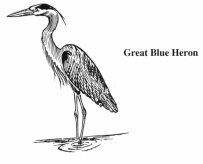 The
Great Blue Heron: Very large, long-legged, 1.25 m
tall or more, mainly grey with a white head with two black
stripes. They have a long bill. Their lower neck and breast
has a ruffle of long, thin, hanging feathers. They often
nest communally in rookeries. They hunt for various aquatic
wildlife, including fish, mostly during the day. Protected
by MBCA.
The
Great Blue Heron: Very large, long-legged, 1.25 m
tall or more, mainly grey with a white head with two black
stripes. They have a long bill. Their lower neck and breast
has a ruffle of long, thin, hanging feathers. They often
nest communally in rookeries. They hunt for various aquatic
wildlife, including fish, mostly during the day. Protected
by MBCA. 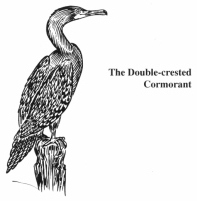 The Double-crested Cormorant: A
large, very dark bird (0.75 to 1 m in length). They often
stand with their wings partially outstretched. They inhabit
open, larger bodies of water where they fish by diving from
the surface. Protected by MBCA.
The Double-crested Cormorant: A
large, very dark bird (0.75 to 1 m in length). They often
stand with their wings partially outstretched. They inhabit
open, larger bodies of water where they fish by diving from
the surface. Protected by MBCA. 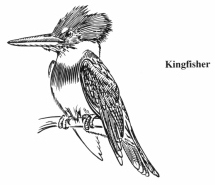 The
Belted Kingfisher: Grey-blue and white bird with
a pronounced crest. They are about 30 cm long with a heavy
pointed bill. Kingfishers mostly perch above their fishing
station and dive headfirst into the water to catch small
fish and other prey. Protected by GAFA.
The
Belted Kingfisher: Grey-blue and white bird with
a pronounced crest. They are about 30 cm long with a heavy
pointed bill. Kingfishers mostly perch above their fishing
station and dive headfirst into the water to catch small
fish and other prey. Protected by GAFA. 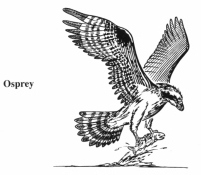
The Osprey: A powerful hawk-like bird, sometimes called the Fish Hawk. The birds, brown above and white below, stand about 30 cm high and have a wing span of nearly 2 m. They nest on dead trees, utility poles, pylons, and floating buoys. Protected by GAFA.
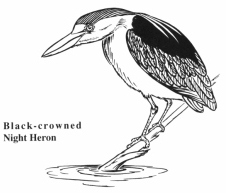 The Black-crowned
Night Heron: A medium-sized bird about 30 cm
long. They are mainly fish eaters, feeding mainly at dusk
and dawn. The adults have a black crown and back, grey
wings, and white neck and underbelly. They have short legs
by comparison with Great Blue Herons so only their feet show
when they are in flight. Protected by MBCA.
The Black-crowned
Night Heron: A medium-sized bird about 30 cm
long. They are mainly fish eaters, feeding mainly at dusk
and dawn. The adults have a black crown and back, grey
wings, and white neck and underbelly. They have short legs
by comparison with Great Blue Herons so only their feet show
when they are in flight. Protected by MBCA. 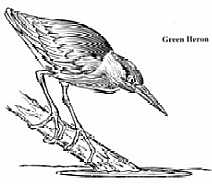 The Green or
Green-backed Heron: A small heron with a green
back and reddish underbelly. Occurs mainly in southern
Ontario. Occasionally sighted at fish farms.
The Green or
Green-backed Heron: A small heron with a green
back and reddish underbelly. Occurs mainly in southern
Ontario. Occasionally sighted at fish farms.
BIRDS WHICH MAY BE MISIDENTIFIED AS
PREDATORS
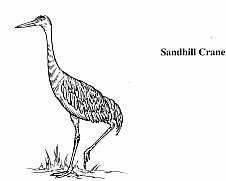 The
Sandhill Crane: Very large, long-legged, 1.25 m
tall with a wing-span of over 2 m. They are brownish-grey
with a reddish cap over their heads above the eyes. They
lack the head stripes and ruffle (bib) feathers of the Great
Blue Heron, have a shorter bill, and are generally paler in
colour. Although they feed on various aquatic animals, they
are NOT known to consume fish. They also eat much aquatic
and terrestrial plant material. They are uncommon in Ontario
and found mostly in the northern and western parts of the
Province. Protected by MBCA.
The
Sandhill Crane: Very large, long-legged, 1.25 m
tall with a wing-span of over 2 m. They are brownish-grey
with a reddish cap over their heads above the eyes. They
lack the head stripes and ruffle (bib) feathers of the Great
Blue Heron, have a shorter bill, and are generally paler in
colour. Although they feed on various aquatic animals, they
are NOT known to consume fish. They also eat much aquatic
and terrestrial plant material. They are uncommon in Ontario
and found mostly in the northern and western parts of the
Province. Protected by MBCA. 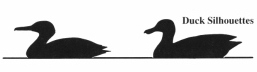 Ducks and Geese:
These birds are largely herbivorous although several species
also feed on aquatic animals. Some also feed on very small
fish from time to time. They are not considered to be
problems for fish farmers. Protected by MBCA.
Ducks and Geese:
These birds are largely herbivorous although several species
also feed on aquatic animals. Some also feed on very small
fish from time to time. They are not considered to be
problems for fish farmers. Protected by MBCA.
FISH-EATING BIRDS NOT PROBLEMATIC AT
FISH FARMS
The Common Loon: They are the
characteristic, handsome, black and white birds associated
with the yodelling cry of the lakes of the north woods.
Protected by MBCA.
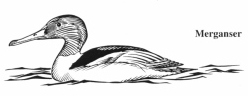 Mergansers:
These are the Fish Ducks. They have narrow bills by
comparison with other ducks and geese. Three species known
to occur in Ontario: the Hooded Merganser, the Red-Breasted
Merganser, and the Common Merganser. Their bodies are long
and slim and their bills are reddish and narrow. The males
and females are differently coloured: female with a red head
and shaggy crest; the male with a green head and crest
inconspicuous in the Common Merganser. Protected by MBCA.
Mergansers:
These are the Fish Ducks. They have narrow bills by
comparison with other ducks and geese. Three species known
to occur in Ontario: the Hooded Merganser, the Red-Breasted
Merganser, and the Common Merganser. Their bodies are long
and slim and their bills are reddish and narrow. The males
and females are differently coloured: female with a red head
and shaggy crest; the male with a green head and crest
inconspicuous in the Common Merganser. Protected by MBCA.Grebes: The species which occur in Ontario are the Pied Grebe, the Horned Grebe, and the Red-necked Grebe. Protected by MGCA.
Bitterns: The American Bittern and the Least Bittern both occur in Ontario. Protected by MBCA.
Gulls: The Ring-billed Gull and Herring Gull are year round residents of Ontario. Protected by MBCA.
Terns: Slender, gull-like birds with long, narrow wings and forked tails. The Common Tern and Black Tern are the two species which occur frequently in Ontario. Protected by MBCA.
Coot and Moorhen: The American Coot and Common Moorhen. Protected by MBCA.
METHODS OF PREVENTION AND CONTROL
The most effective methods for deterring bird predators on
fish farms in Ontario would be complete or partial
enclosures. Enclosures can be built with a combination of
fencing, top screening, netting, and wires. Bird scaring devices such as gas-operated exploders, electronic noise-makers, and animal silhouettes (eg. owls) have been used but with variable success. The devices work best for temporary, intensive harassment programs. It is best to put these devices in more secluded areas of the farm site or in areas where newly stocked fry are kept.
Before establishing a fish farm one should carefully consider the location. Building aquaculture facilities away from an established heronry or breeding area can reduce potential predator problems. Maintaining netting and screens in good working order will help to keep birds out of ponds and raceways. Removal of dead fish, and removal of vegetation that may encourage birds to perch and nest, is encouraged.
RESOURCE PERSONNEL FOR ADVICE
Aquaculture Extension CentreDepartment of Animal and Poultry Science
University of Guelph
Guelph, Ontario N1G 2W1
Richard Moccia
Telephone: 519-824-4120 extension 6216
FAX: 519-767-0573
REFERENCES RECOMMENDED FOR FURTHER
READING
ACKNOWLEDGEMENT